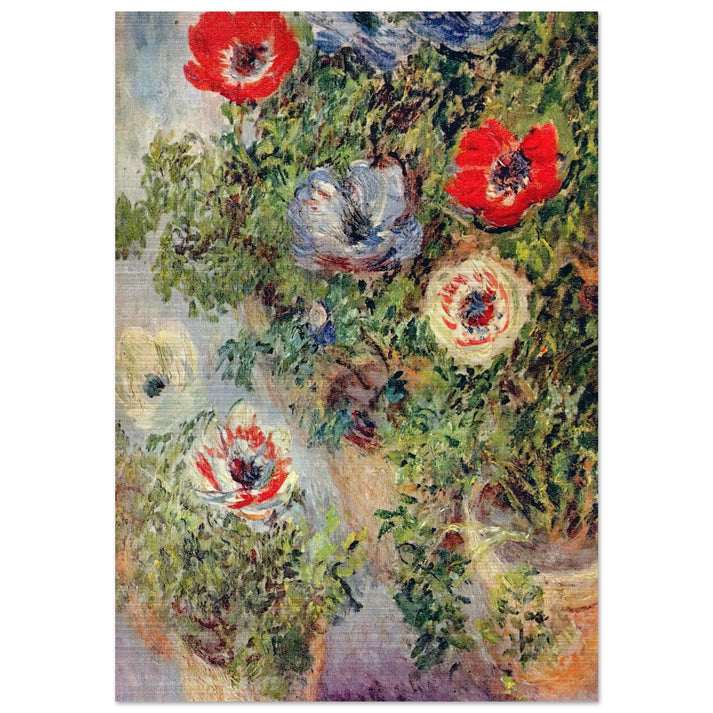


Stilleben mit Anemonen - claude monet Aluminiumdruck - 70x100 cm / 28x40 Zoll | claude monet Aluminiumdruck | claude monet Drucke
Stilleben mit Anemonen - claude monet Aluminiumdruck - 70x100 cm / 28x40 Zoll | claude monet Aluminiumdruck | claude monet Drucke
Verfügbarkeit für Abholungen konnte nicht geladen werden
Claude Monets „Stillleben mit Anemonen“ – Ein Aluminiumdruck in gebürstetem Silber mit leuchtendem Impressionismus
Tauchen Sie ein in die strahlende Schönheit von Claude Monets „Stillleben mit Anemonen“ mit dieser musealen Reproduktion von RedKalion. Dieser exquisite Fine-Art-Druck fängt das zarte Zusammenspiel von Licht und Farbe ein, das Monets impressionistische Meisterschaft ausmacht, und verwandelt eine einfache Blumendarstellung in ein lebendiges Studium der vergänglichen Anmut der Natur.
Gemalt im späten 19. Jahrhundert, zeigt dieses Werk Monets revolutionären Ansatz zur Erfassung flüchtiger Momente. Die Anemonen, mit lockeren, ausdrucksstarken Pinselstrichen dargestellt, scheinen im Umgebungslicht zu tanzen, ihre leuchtenden Farben kontrastieren mit dem sanften Hintergrund. Dieses Stück schmückt nicht nur einen Raum, sondern lädt auch zur Betrachtung der Fähigkeit der Kunst ein, die Zeit einzufrieren.
RedKalions Premium-Aluminium-DIBOND®-Druck in gebürstetem Silber veredelt dieses Meisterwerk mit einem metallischen Finish und horizontaler Maserung, was Monets klassischer Komposition einen dynamischen, zeitgenössischen Twist verleiht. Mit den Maßen 70x100 cm (28x40 Zoll) und einer Dicke von 3 mm (0,12 Zoll) bietet er eine stabile, formstabile Präsentation. Der Direktdruck auf AluDibond garantiert lebendige Farben und eine matte Oberfläche, während unbedruckte Bereiche einen dezenten metallischen Silbereffekt zeigen, der die Leuchtkraft des Kunstwerks verstärkt. Komplett mit Montageset ist dieses Stück bereit, Ihr Zuhause oder Büro mit zeitloser Eleganz zu schmücken.
Als vertrauenswürdiger Kurator von archivwürdigen Reproduktionen verbindet RedKalion kunsthistorisches Fachwissen mit modernster Drucktechnologie. Monets Technik des Auftragens reiner Pigmente, um optische Lebendigkeit zu erzeugen, wird originalgetreu nachgebildet, sodass Sie dieselbe visuelle Wirkung wie das Original erleben können. Bereichern Sie Ihre Umgebung mit einem Druck, der die Innovation des 19. Jahrhunderts mit moderner Haltbarkeit verbindet.
```


Discover Unlimited Art Possibilities
At RedKalion, you can find virtually any artwork from any artist, available in a wide range of sizes to perfectly match your space.
If you didn’t find what you’re looking for, contact us at support@redkalion.com . We will source any artwork and produce it in any size and format you need, including art prints, posters, canvas, framed pieces, framed canvas, and more.
For dedicated art enthusiasts, we also offer handcrafted replicas of any artwork, carefully painted by highly skilled artists using traditional techniques.
For custom requests, contact us at support@redkalion.com .
What are the dimensions and material of this Claude Monet print?
This Claude Monet fine art print measures 70x100 cm (28x40 inches) and is crafted from brushed silver Aluminum DIBOND® with a 3mm thickness, offering a durable, museum-quality reproduction with a metallic finish.
How does the printing on Aluminum DIBOND® enhance the artwork?
The direct print on AluDibond provides vivid colors and a matte, glare-free finish, while unprinted white areas reveal a metallic silver effect, adding depth to Monet's Impressionist brushstrokes in this premium art print.
Is a hanging kit included with the brushed aluminum print?
Yes, a hanging kit is included with your order; specific components may vary by fulfillment country to ensure secure installation of your Claude Monet aluminum print.
What makes this a museum-quality reproduction?
RedKalion uses archival-grade materials and precise color matching to replicate Monet's original hues and textures, ensuring this brushed aluminum print meets high standards for fine art reproductions.
How should I care for my aluminum print to ensure longevity?
Gently dust with a soft, dry cloth; avoid harsh chemicals. The Aluminum DIBOND® base and matte finish are designed for durability, making this Claude Monet print a long-lasting addition to your collection.
What is the historical significance of "Still Life with Anemones" by Claude Monet?
Painted in the late 19th century, this work exemplifies Monet's Impressionist focus on light and color, using anemones to explore natural beauty and transient moments, marking a shift from traditional still life art.
Why did Monet choose anemones for this still life painting?
Monet often selected flowers like anemones for their vibrant colors and symbolic associations with spring and renewal, allowing him to experiment with light effects and emotional resonance in his floral studies.