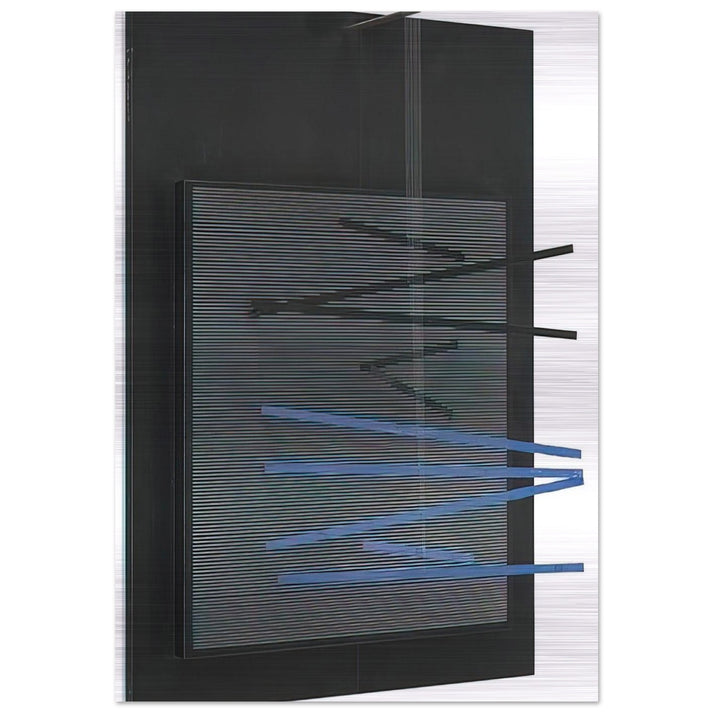


KLEINE VIBRATION ZIEGELSTEIN UND SCHWARZ 1966 - Jesus Rafael Soto Aluminiumdruck - 70x100 cm / 28x40 Zoll | Jesus Rafael Soto Aluminiumdruck | Jesus Rafael Soto Drucke
KLEINE VIBRATION ZIEGELSTEIN UND SCHWARZ 1966 - Jesus Rafael Soto Aluminiumdruck - 70x100 cm / 28x40 Zoll | Jesus Rafael Soto Aluminiumdruck | Jesus Rafael Soto Drucke
Verfügbarkeit für Abholungen konnte nicht geladen werden
Petite Vibration Brique et Noire 1966 von Jesús Rafael Soto
Erleben Sie die kinetische Energie von Jesús Rafael Sotos Petite Vibration Brique et Noire 1966, ein wegweisendes Werk der Op-Art-Bewegung, das Wahrnehmung und Bewegung durch geometrische Abstraktion erforscht. Diese museumreife Reproduktion fängt das präzise Zusammenspiel von ziegelroten und schwarzen Linien ein und erzeugt eine optische Illusion der Vibration, die die Sinne des Betrachters anspricht. Soto, ein venezolanischer Künstler und Pionier der kinetischen Kunst, manipuliert meisterhaft Raum und Form, um statisches Betrachten zu hinterfragen, wodurch dieses Werk zu einem dynamischen Highlight für jedes moderne Interieur wird.
RedKalion präsentiert dieses ikonische Kunstwerk als Premium-Bürstenaluminiumdruck, gefertigt aus archivbeständigen Materialien für anhaltenden Glanz. Direkt auf 3 mm dickem Aluminium DIBOND® mit metallischer Oberfläche und horizontaler Maserung gedruckt, bietet es lebendige Farben und eine matte, blendfreie Oberfläche, die das Schwarz-Weiß-Design unterstreicht und gleichzeitig in unbedruckten Bereichen einen markanten silbernen Bürsteneffekt offenbart. Jeder Druck enthält ein Aufhängeset für eine einfache Installation, sodass er bereit ist, Ihren Raum mit einem langlebigen, stabilen Meisterwerk zu bereichern.
Als vertrauenswürdiger Kurator von hochwertigen Kunstprints verbindet RedKalion kunsthistorisches Fachwissen mit modernsten Reproduktionstechniken. Dieses Werk ehrt nicht nur Sotos Vermächtnis, sondern bietet auch eine archivbeständige Investition, die Bestand hat – perfekt für Sammler und Designbegeisterte, die ihrem Umfeld kinetische Eleganz verleihen möchten.
```


Discover Unlimited Art Possibilities
At RedKalion, you can find virtually any artwork from any artist, available in a wide range of sizes to perfectly match your space.
If you didn’t find what you’re looking for, contact us at support@redkalion.com . We will source any artwork and produce it in any size and format you need, including art prints, posters, canvas, framed pieces, framed canvas, and more.
For dedicated art enthusiasts, we also offer handcrafted replicas of any artwork, carefully painted by highly skilled artists using traditional techniques.
For custom requests, contact us at support@redkalion.com .
What are the dimensions and materials of this Jesús Rafael Soto aluminum print?
This fine art print measures 70x100 cm (28x40 inches) and is made from brushed silver Aluminum DIBOND® with a 3mm thickness, featuring a direct print for vivid colors and a matte finish with a metallic silver effect.
How does the brushed aluminum finish enhance the artwork's visual impact?
The brushed silver finish adds a dynamic, metallic look with horizontal grain, ideal for black-and-white designs, creating a striking contrast and glare-free surface that highlights Soto's kinetic patterns.
Is a hanging kit included with this museum-quality reproduction?
Yes, a hanging kit is included with your order; specific components may vary by fulfillment country to ensure secure and easy installation.
What makes this print archival and durable for long-term display?
Crafted with direct printing on Aluminum DIBOND®, this print offers archival longevity, resisting fading and damage, thanks to its 3mm rigid base and high-quality materials.
How does RedKalion ensure the accuracy of this Jesús Rafael Soto reproduction?
RedKalion uses expert color matching and premium printing techniques to faithfully replicate Soto's original 1966 work, ensuring a true-to-life museum-quality reproduction.
What is the historical significance of Petite Vibration Brique et Noire 1966?
Created during Soto's peak in the Op Art movement, this piece exemplifies his exploration of vibration and perception through geometric abstraction, influencing kinetic art globally.
Can you describe the artistic technique behind Soto's use of color and line in this work?
Soto employs precise, alternating brick-red and black lines to create optical illusions of movement, a technique that challenges viewers' visual perception and engages spatial dynamics.