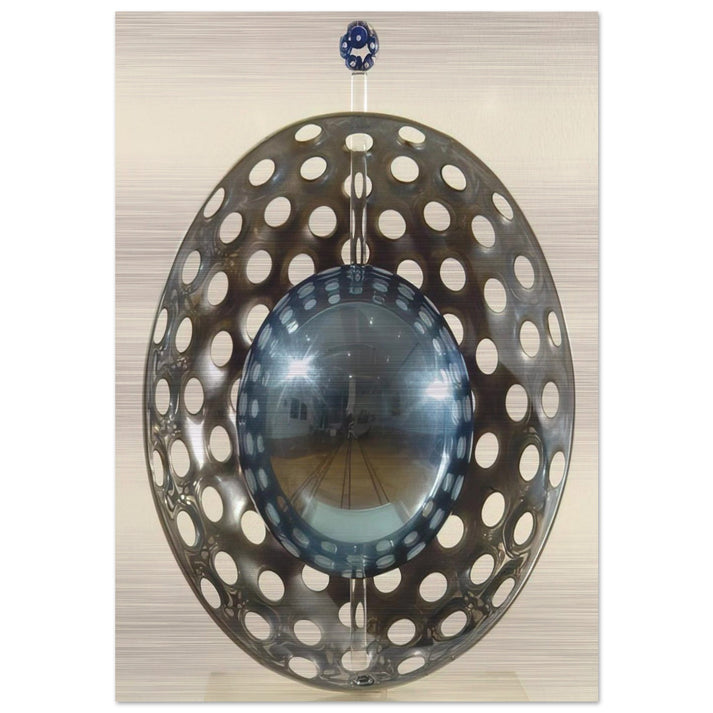


Perforationen mit Reflexion - 1967 - Gyula Kosice Aluminium-Druck - 70x100 cm / 28x40 Zoll | Gyula Kosice Aluminium-Druck | Gyula Kosice Drucke
Perforationen mit Reflexion - 1967 - Gyula Kosice Aluminium-Druck - 70x100 cm / 28x40 Zoll | Gyula Kosice Aluminium-Druck | Gyula Kosice Drucke
Verfügbarkeit für Abholungen konnte nicht geladen werden
Perforationen mit Reflexion (1967) von Gyula Kosice
Tauchen Sie ein in die kinetische Brillanz von Gyula Kosices Perforationen mit Reflexion (1967), einem bahnbrechenden Werk des argentinischen Avantgarde-Meisters. Dieser gebürstete silberne Aluminium-DIBOND®-Druck fängt die Essenz von Kosices visionärer Sichtweise ein, in der Licht, Raum und Bewegung in einer dynamischen Komposition aus Perforationen und Reflexionen verschmelzen. Als führende Figur der MADI-Bewegung revolutionierte Kosice die moderne Kunst, indem er industrielle Materialien und geometrische Abstraktion integrierte und Werke schuf, die zur Kontemplation und Interaktion einladen. Unsere museumswürdige Reproduktion stellt jedes Detail – von den präzisen Perforationen bis zum subtilen metallischen Schimmer – originalgetreu dar und bietet ein Stück Kunstgeschichte, das jede Umgebung verwandelt.
Dieser 70x100 cm / 28x40 Zoll Druck wird auf 3 mm (0,12") dickem gebürstetem silbernem Aluminium DIBOND® gefertigt und weist eine horizontale Maserung auf, die seine visuelle Tiefe und moderne Ästhetik verstärkt. Die Direktdruck-Technologie auf AluDibond liefert lebendige, langlebige Farben mit einer mattierten, blendfreien Oberfläche, während unbedruckte Bereiche einen markanten metallisch-silbernen Effekt zeigen, perfekt, um die Schwarz-Weiß-Kontraste des Kunstwerks hervorzuheben. Jeder Druck enthält ein Aufhängeset für eine einfache Installation und ist bereit, Ihren Wohnraum, Ihr Büro oder Ihre Galerie mit archivbeständiger Haltbarkeit zu bereichern.
Bei RedKalion spezialisieren wir uns auf die Kuratierung hochwertiger Reproduktionen, die die Integrität der Originalkunstwerke bewahren. Unser Druck Perforationen mit Reflexion ist nicht nur eine Dekoration, sondern ein Zeugnis von Kosices innovativem Geist, der dazu bestimmt ist, über Generationen hinweg zu inspirieren und zu bestehen. Entdecken Sie unsere Kollektion, um mehr Gyula Kosice-Drucke und andere hochwertige Kunstreproduktionen zu finden, die alle mit dem gleichen Engagement für Exzellenz und Authentizität gefertigt werden.
```


Discover Unlimited Art Possibilities
At RedKalion, you can find virtually any artwork from any artist, available in a wide range of sizes to perfectly match your space.
If you didn’t find what you’re looking for, contact us at support@redkalion.com . We will source any artwork and produce it in any size and format you need, including art prints, posters, canvas, framed pieces, framed canvas, and more.
For dedicated art enthusiasts, we also offer handcrafted replicas of any artwork, carefully painted by highly skilled artists using traditional techniques.
For custom requests, contact us at support@redkalion.com .
What is the historical significance of Perforaciones con reflexión by Gyula Kosice?
Created in 1967, this work exemplifies Gyula Kosice's role in the MADI movement, blending industrial materials like aluminum with geometric abstraction to explore light, space, and kinetic art in Argentine avant-garde history.
How does the brushed silver Aluminum DIBOND® enhance this fine art print?
The 3mm thick brushed silver Aluminum DIBOND® provides a durable, rigid base with a horizontal grain and metallic finish, creating a dynamic look that highlights the artwork's matte, glare-free reproduction and vivid colors.
What are the dimensions and material specifications of this museum-quality reproduction?
This print measures 70x100 cm / 28x40 inches, made from 3mm brushed silver Aluminum DIBOND® with direct printing for a matte finish and metallic silver effects in unprinted areas, ensuring archival longevity.
Is a hanging kit included with this Gyula Kosice aluminum print?
Yes, a hanging kit is included with every order, though it may vary by fulfillment country to ensure secure and easy installation for your premium art piece.
How does the printing technique affect the colors and finish of this artwork?
Direct print on AluDibond technology delivers vivid colors and a matte, glare-free finish, while unprinted white areas reveal a metallic silver effect, ideal for black-and-white designs with striking visual impact.
What artistic techniques did Gyula Kosice use in his 1967 works?
In 1967, Kosice employed perforations, reflections, and industrial materials like aluminum to create kinetic and geometric abstractions, pushing boundaries in the MADI movement for interactive and spatial art experiences.
Why is this print considered an archival-grade reproduction?
It uses high-quality Aluminum DIBOND® and advanced printing methods to resist fading and damage, making it a durable, museum-quality piece that preserves Kosice's artistic legacy for long-term display.